Fossil Facts > Crinoid
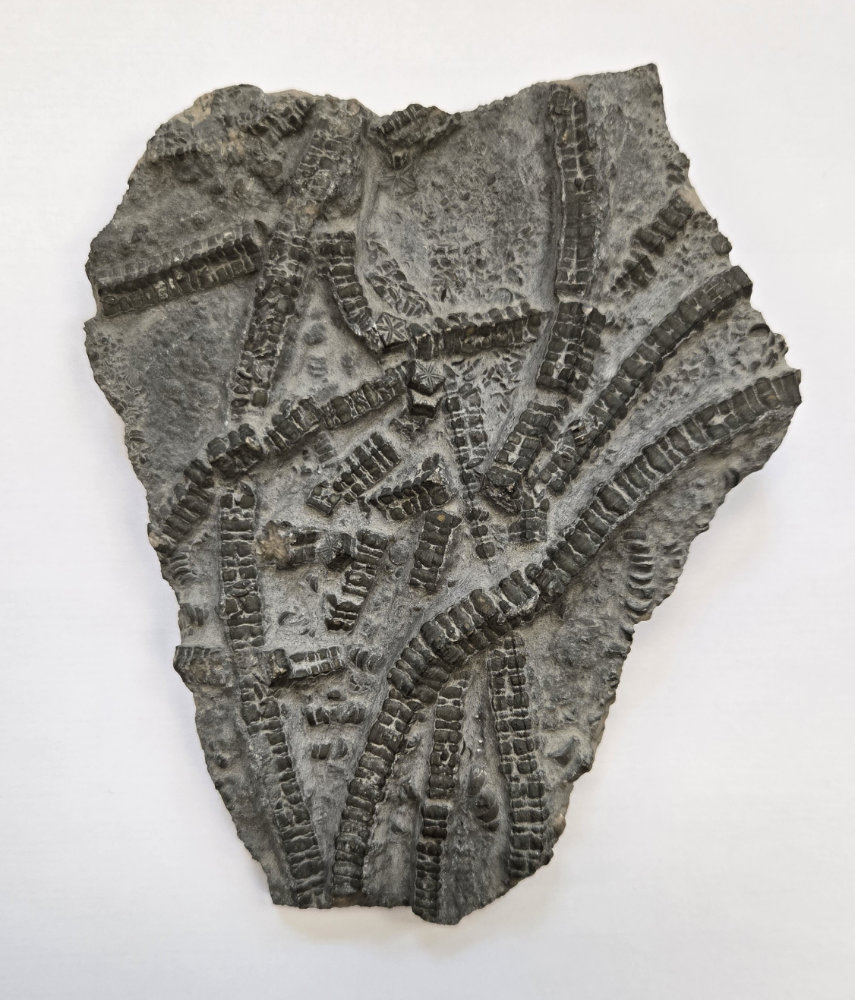
Crinoids, or commonly ‘sea lilies’ are not a actually a plant, they’re an animal that just happens to look a bit like a plant. They are represented by roughly 700 living species today but were far more diverse and abundant in the past. Crinoids are from the phylum called echinoderms. Echinoderms (which means spiny skin) also contains the starfish and brittlestars, sea urchins and sea cucumbers.
Typically, fossil crinoids are made up of 4 main body parts which you can find fossilised. Firstly, is the holdfast, which serves an anchor-like function to attach the animal to a surface. Secondly, the most common part, which is the stem/stalk. The stem is made up of individual pieces called ossicles. Here in Lyme Regis the crinoids we find have ossicles which look like stars stacked on top of one another. Thirdly at the top of the stem is the cup (the calyx) which holds the main body of the animal. Lastly are the branching arms it used to filter feed.
The sections of the star shaped stems are a common find can be found loose amongst the pebbles and shingle, but you can also find pieces of the crinoid branching arms preserved in pyrite (fool’s gold) and calcite if you are lucky.