Fossil Facts > Ichthyosaurs


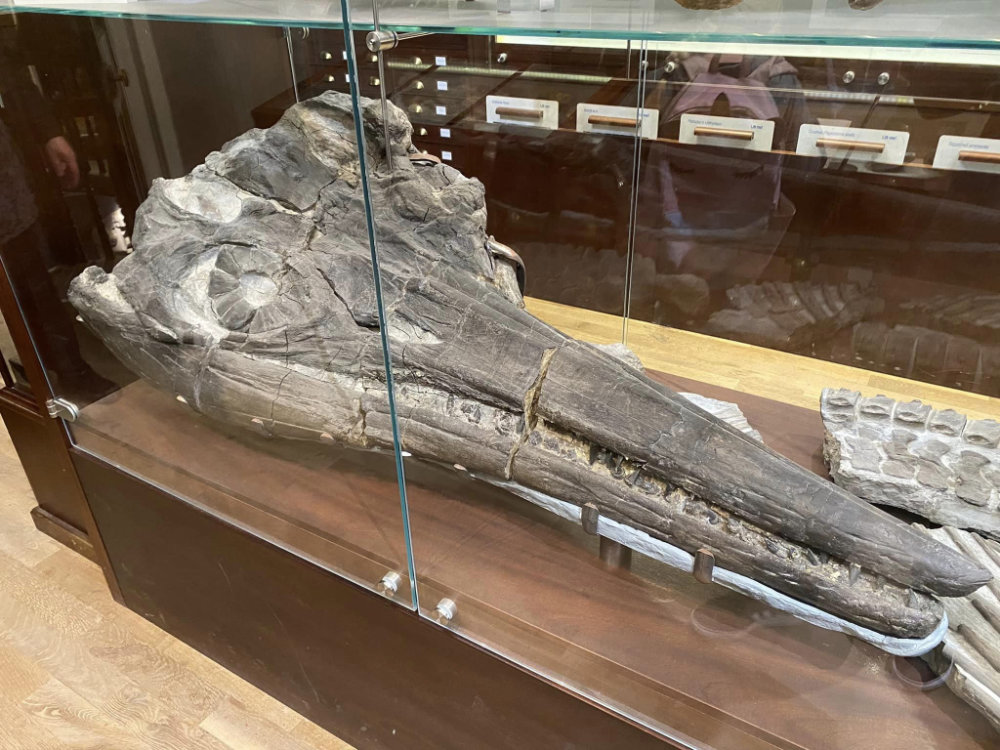
Ichthyosaurs (fish-lizards) were a diverse group of marine reptiles that lived during the Mesozoic Era. They are often mistaken as dinosaurs but were actually a unique group of reptiles that evolved to live in the ocean. Their name translates as and happened to look very similar to dolphins, resulting from a process called convergent evolution.
In 1811, Joseph Anning, found the skull of an ichthyosaur and Mary Anning discovered the rest of the skeleton the following year. This wasn’t the first ichthyosaur fossil to be found but it was the first ichthyosaur to be scientifically described. A replica of this skull can be seen in our geology gallery.
Ichthyosaurs came in a variety of sizes, with the largest being a genus called Temnodontosaurus, a genus of ichthyosaur which could reach lengths of up to 5m long. It was this genus to which Joseph and Mary’s aforementioned ichthyosaur eventually became assigned to.
The most iconic and likely bone that you may find of an ichthyosaur is a vertebra (backbone), given that they had more vertebrae than other bones in its body and they are very robust and so can survive on the beach when washed from the clays and muds. Vertebrae are usually round to hexagonal in shape, with a concave dip in the middle on either side. Sometimes if you’re lucky, you can find multiple vertebrae still connected to one another. Fossil bone is typically black or dark brown in colour and is typically found loose in the shingle, under rocks, boulders and in rockpools.