

Lyme Regis Museum honoured with prestigious national award from Arts Council England
Lyme Regis Museum is delighted to announce its outstanding Jurassic Coast Geology Collection has been awarded Designated Status by Arts Council England.
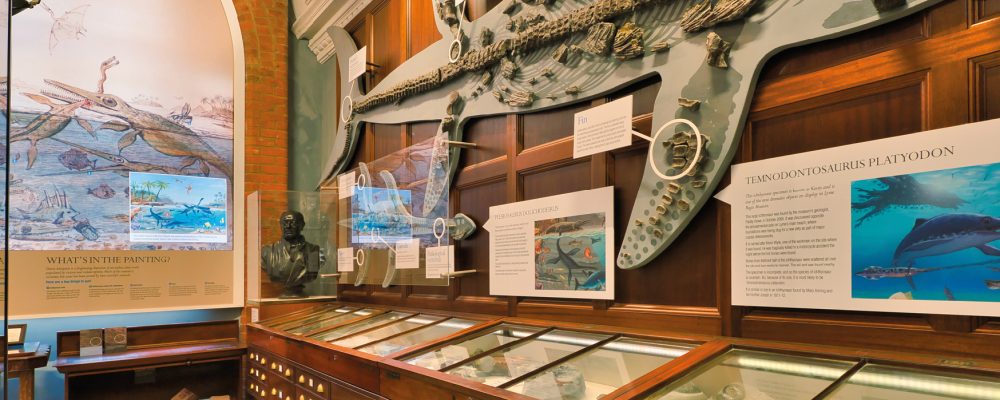
Founded in 1923, Lyme Regis Museum has an incredible Geology Collection – one of the founding collections of the museum – which offers a remarkable insight into the history, science and geology of the Jurassic Coast, the birthplace of palaeontology, and the inspirational female scientist Mary Anning.
The Museum is described by David Attenborough as “A remarkable museum, a gem”
On receiving the prestigious award, Museum Director Bridget Houseago said, “Lyme is widely considered the birthplace of palaeontology and I am delighted that our exceptional collection has been recognised by the Arts Council England Designation Panel. The Museum’s Jurassic Coast Collection includes many rare, stunning and scientifically important fossils, that offer a remarkable insight into life on our planet and our understanding of the world. I hope this award will encourage more people to visit the Museum and enable us to continue to develop our important work with scientists and researchers around the country.”
Museum Chair of Trustees, Jonathan Evans said, “The Museum team has been working towards achieving Designated Status for our geology collection for several years. Granting of Designated Status by Arts Council England is an important milestone for the Museum and recognises the local, national and international importance of the collection. We hope to build on this to continue to improve and expand our collection through targeted collection and acquisition over the coming years”
The award recognises that the Lyme Regis Museum collection is of national and international significance, representing the birthplace of palaeontology and one of the most important geological landscapes in Britain. Rooted in discoveries made along the Jurassic Coast, a UNESCO World Heritage Site, the collection documents a scientific revolution that transformed understanding of Earth’s history in the early 19th century.
Darren Henley, Chief Executive, Arts Council England said, “From tiny preserved fauna to the fossils of sea creatures, the Jurassic Coast Collection celebrates the birthplace of palaeontology and Britain’s ancient life. I congratulate everyone at Lyme Regis Museum on this Designation award. The team have dug deep to bring the story of this remarkable geological landscape to life, and the collection will inspire generations to come.”
The Museum’s exceptional geology and fossil collections include exquisitely preserved Jurassic fauna and flora, from ammonites and fossil fish to large marine reptiles such as ichthyosaurs, including many rare and scientifically important specimens. Of particular national importance is material linked to the earliest development of palaeontology, including one of the first dinosaur fossils ever described: a juvenile Scelidosaurus studied by Richard Owen, who coined the term Dinosauria and became the first Superintendent of the Natural History Museum.
Lyme Regis was the epicentre of this scientific awakening. Discoveries made there, most notably by Fossil Hunter Mary Anning, challenged established beliefs, reshaped scientific thought, and directly influenced emerging ideas about deep time, extinction and evolution. The Museum stands on the site of Mary Anning’s birthplace, giving the collection a uniquely powerful connection between place, people and discovery.
Through its selective and active collecting policy, the Museum continues to acquire fossils of scientific and local significance, ensuring the collection remains relevant to ongoing research and public understanding. Together, these holdings form a cohesive and nationally important record of the origins of palaeontology, the development of geological science, and the enduring global importance of the Jurassic Coast.
The Designation award is a marker of the significance of Lyme Regis Museum’s Geology Collection and the Museum is only the fifth collection in the South West to be awarded Designated Status for Geology.
The application was strongly supported by notable academics and professionals in the field of palaeontology. Professor Mike Benton from the University of Bristol said, “The Lyme Regis Museum collections are of international standing, partly because of their association with Mary Anning, but more importantly because they include specimens collected by her over 200 years ago, but mostly collections accumulated since then, and continuing today. The Jurassic Coast UNESCO site attracts huge interest from the public and scientific researchers alike, and the Lyme Regis Museum is the leading museum associated with that World Heritage Site.”
Professor Richard Twitchett, Research Leader in Palaeoenvironmental Change at the Natural History Museum, London wrote in a supporting letter that “As palaeontological researchers and curators, we have all witnessed firsthand throughout our careers the importance that Lyme Regis Museum collections have for our science. Built up since the early 1800s, the collections are of national and international significance for the history of geology, containing key specimens collected by or related to notable individuals such as Mary Anning, William Buckland and Henry de la Beche, and also for current research on fossil marine vertebrates; ecosystems of the Lower Jurassic; and the response of marine ecosystems to mass extinction events and climate change.”